A Weekly Art Appreciation Journal That Lasts
A museum visit can leave behind a strange dissatisfaction: you know you saw something significant, yet a few days later the work has dissolved into a general impression. A weekly art appreciation journal offers a different rhythm. It gives attention somewhere to go after the first encounter, turning a passing response into an evolving practice of looking, questioning, and remembering.
This is not a planner decorated with famous paintings, nor a blank notebook waiting for inspiration to strike. At its best, an art journal is a deliberately structured companion for serious curiosity. It asks you to return to images with greater patience and to notice how your own judgments change over time.
Why Art Appreciation Needs a Weekly Rhythm
Art asks more of us than recognition. Knowing that a painting is by Georgia O'Keeffe or that a building belongs to the Bauhaus tradition can be useful, but recognition alone is not appreciation. Appreciation begins when we stay with the work long enough to register its decisions: the pressure of a line, an awkward crop, a particular use of repetition, the emotional temperature of a color.
A weekly cadence is especially well suited to this kind of attention. It is frequent enough to establish continuity, but spacious enough to avoid turning culture into another daily obligation. One work, artist, movement, or question per week creates room for research, reflection, and revision. The point is not to cover the maximum amount of art history. It is to develop the habit of meeting art with increasing precision.
Over 52 weeks, small encounters accumulate. You begin to recognize formal patterns across periods, notice recurring subjects in your own responses, and build a more reliable sense of what moves you and why. That is a more durable form of cultural literacy than a collection of disconnected facts.
What a Weekly Art Appreciation Journal Can Hold
The most rewarding journals balance guidance with interpretive freedom. Too little structure can leave the page empty. Too much can make every encounter feel like an exam. The strongest format offers a clear route into a work while leaving space for private associations, disagreement, and surprise.
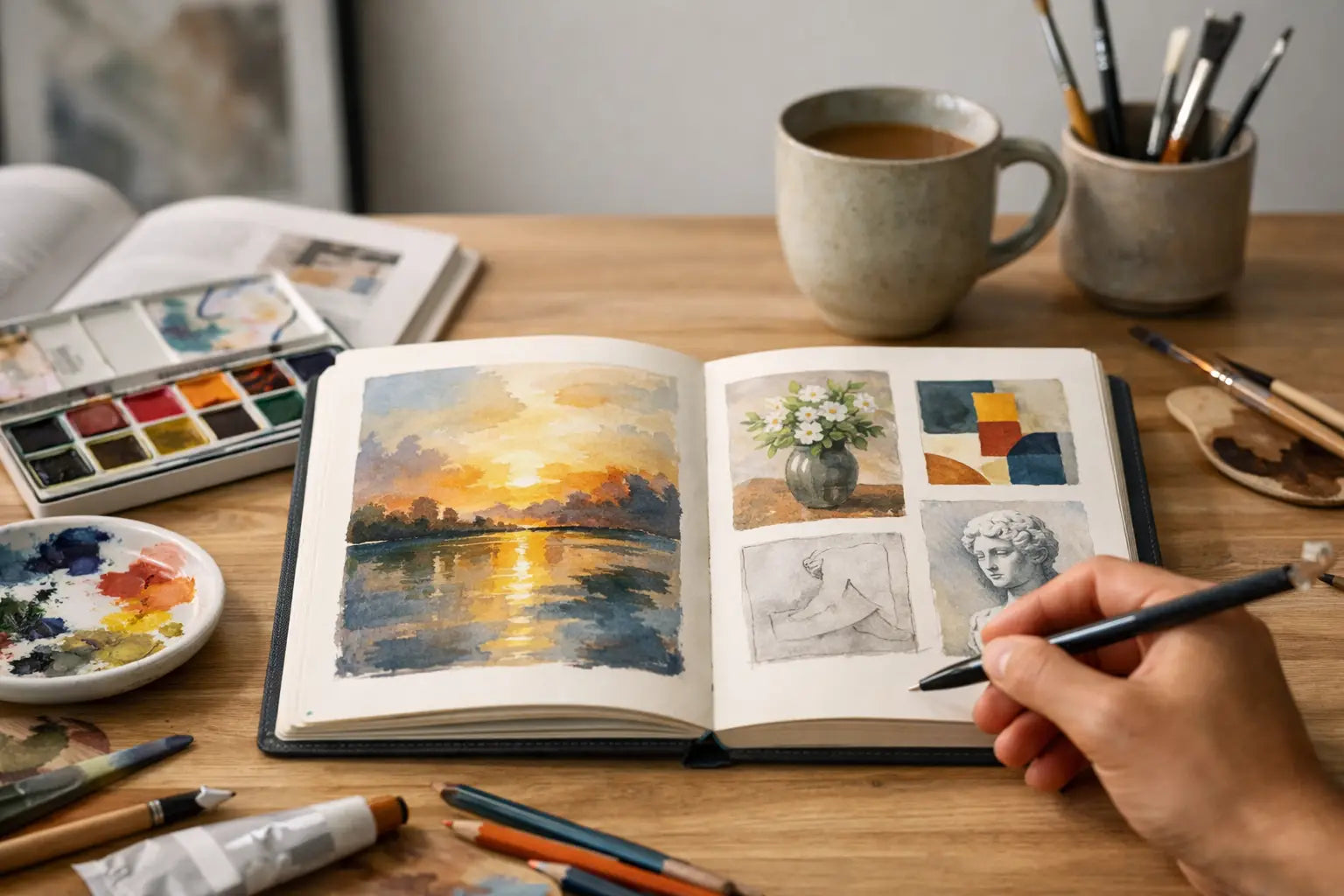
A weekly entry might begin with close observation before introducing context. What do you see first? Where does the eye travel? Which material qualities matter: the grain of a photograph, the density of oil paint, the polished surface of bronze, the scale of an installation? These questions slow down the reflex to decide whether a work is good or bad before it has been properly seen.
Context then complicates the first impression. A brief account of an artist's life, a patron's influence, a political moment, or a technical innovation can sharpen rather than replace personal response. Good art writing does not tell you what to feel. It gives you more to see.
Finally, reflection prompts create a record of encounter. You might consider what the work withholds, what it makes difficult, or what detail continues to return to you. A journal can also invite comparison: place this week's work beside one studied earlier. Has your sense of portraiture, landscape, abstraction, beauty, or provocation shifted?
That sequence matters. Observation, context, interpretation, and personal reflection form a useful discipline because they distinguish an immediate reaction from a considered response without treating either as invalid.
How to Use an Art Journal Without Making It a Chore
The value of a guided journal lies partly in how modest the practice can be. A meaningful session does not require a gallery membership, an art-history degree, or an uninterrupted afternoon. Twenty attentive minutes with a reproduction can be enough, particularly when you return to the same image more than once.
Choose a consistent moment in the week. Sunday morning may suit someone who likes a quiet ritual; Wednesday evening may work better for a person who needs a midweek change of pace. Consistency is useful, but rigidity is not. The journal should become a place of return, not another standard by which to judge your discipline.
When possible, look at the work before reading about it. Cover the accompanying text or set aside your notes for a few minutes. Describe what is physically present without interpreting it too quickly. This simple practice can reveal how much we routinely supply from memory, reputation, or expectation.
Then read the material and respond again. Did the context confirm your first impression, or disturb it? Did a historical detail make the work more legible, or did it expose a question that remains unresolved? The shift between those two responses is often where learning becomes personal.
It also helps to allow uneven weeks. Some entries will produce pages of thought; others may yield three honest sentences. A sparse response is not a failed one. Often, the works that resist easy language deserve another visit later in the year.
The Difference Between Taste and Discernment
Many people hesitate to write about art because they assume they must arrive at the correct interpretation. Yet a mature relationship with art is not built on certainty alone. It is built on the ability to describe, question, compare, and revise.
Taste is personal preference. It may be immediate and entirely sincere: you are drawn to saturated color, skeptical of conceptual art, moved by domestic scenes, or bored by heroic sculpture. Discernment is broader. It asks what a work is attempting, how it is constructed, what conditions shaped it, and whether its choices achieve a particular effect.
A weekly practice makes room for both. You may dislike a work and still recognize its ambition, influence, or formal intelligence. You may love a work while discovering that the reasons for your attachment are more complicated than you first thought. This is not a retreat from feeling. It is a way of giving feeling greater clarity.
That distinction is particularly valuable in an era of rapid visual consumption. Images arrive endlessly, often stripped of scale, sequence, material presence, and history. The journal restores a measure of resistance. It asks you to stay with one image rather than scroll past fifty, and to make meaning rather than merely register preference.
Building a Personal Archive of Looking
By the end of a year, a completed journal becomes more than a record of assignments. It becomes evidence of an interior education. Its pages may reveal the artists you returned to, the subjects that unsettled you, the periods you misunderstood at first, and the visual ideas that gradually became part of your own language.
This archive can be especially meaningful for artists, writers, educators, and musicians, whose work often depends on sustained attention to form. But it is equally useful for anyone seeking a richer relationship with the culture they already love. Art appreciation does not need to lead to professional expertise. It can lead to better questions, stronger memory, and a more attentive daily life.
Digital journals offer a practical advantage here. They can travel easily, be printed selectively, and support a practice that moves between a screen, a library book, a museum visit, and a notebook margin. The trade-off is that digital viewing cannot fully reproduce the bodily scale or texture of every artwork. When you can see a work in person, do. When you cannot, treat the image as an invitation to careful study rather than a substitute for the object itself.
Choosing the Right Weekly Art Appreciation Journal
Not every art journal serves the same purpose. Some are designed for sketching, others for documenting museum visits, and others for broad art-history instruction. The right choice depends on what you want the year to hold.
If you want to strengthen visual analysis, look for prompts that begin with close looking and use accessible language without flattening complexity. If your aim is cultural context, seek editorial material that connects artworks to their historical conditions and artistic conversations. If you are trying to renew your own creative work, choose a journal that pairs appreciation with reflective questions rather than imitation exercises alone.
A well-curated 52-week format has a particular advantage: it creates a coherent body of work without making every week feel identical. Themes can recur and deepen. An early study of color might prepare you to notice color differently in photography months later. A question about the artist's public role may return through different centuries and mediums. That kind of thematic storytelling gives the practice shape.
Conspire Creations® approaches the guided journal as an interpretive learning tool: a structured but humane way to spend a year in conversation with cultural material. The objective is not to finish with a list of correct answers. It is to leave with a more practiced eye and a record of what that eye has learned to notice.
Begin with one work this week. Look longer than feels natural. Write down what you can actually see, then write down what you still cannot explain. That unfinished question may be the most valuable thing on the page.