How an Inventor Biography Journal Builds Insight
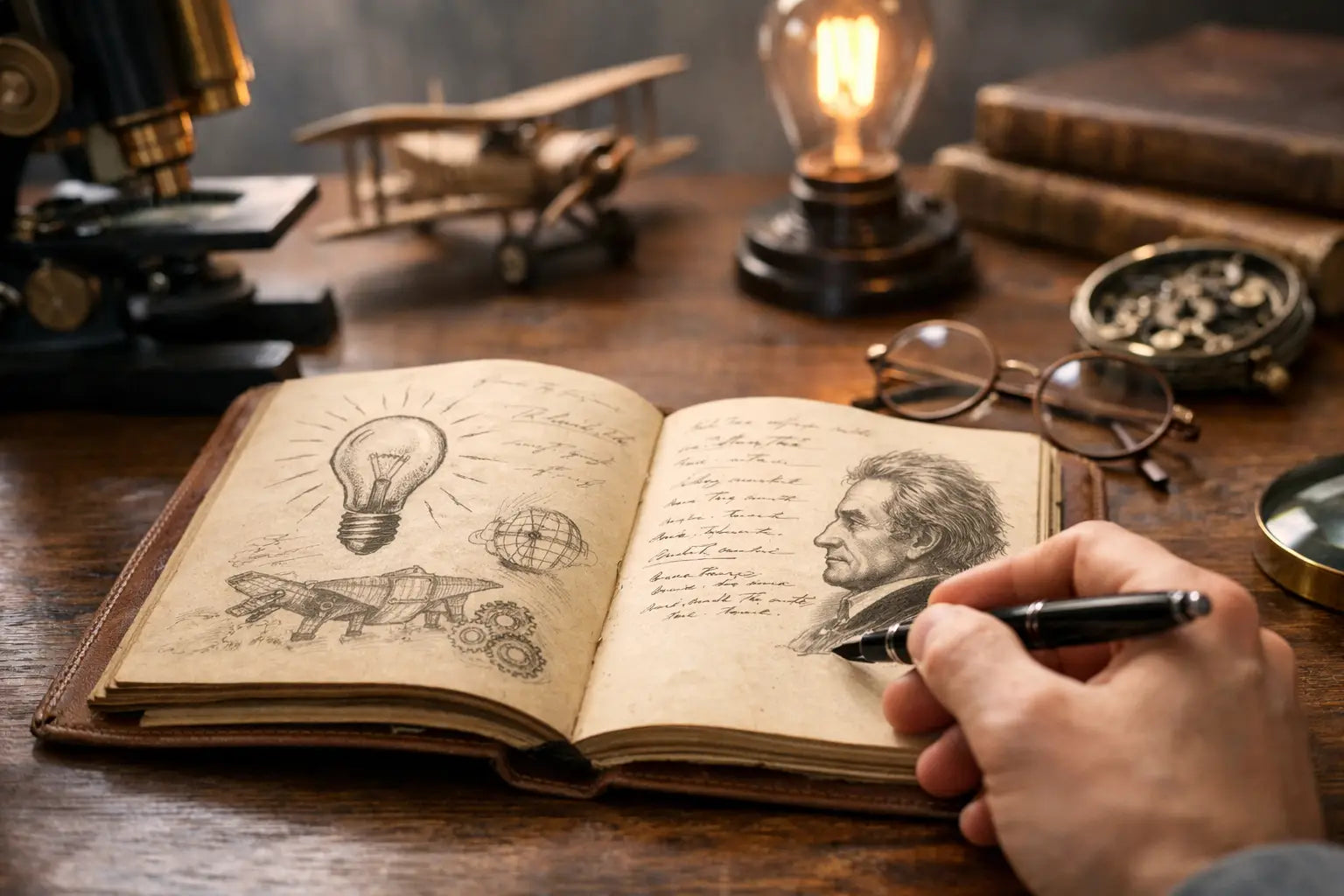
A patent drawing can make invention appear wonderfully clean: a problem, a mechanism, a name in the corner. The lived reality is usually less orderly. An inventor biography journal creates room for the drafts, rivalries, financial pressures, failed trials, collaborators, and moral questions that sit behind an enduring idea. It turns biography from a sequence of impressive facts into a sustained practice of attention.
For readers drawn to history, design, science, and creative work, this is not merely a record of famous people. It is a way to examine how ideas take shape in particular conditions - and how a more deliberate relationship with invention can sharpen one's own thinking.
Why an inventor biography journal matters
The conventional inventor story is often built around a solitary genius. A person sees what no one else can see, perseveres, and changes the world. Such stories can be inspiring, but they flatten the very circumstances that make invention worth studying.
Inventors work within networks. They borrow tools, respond to prior discoveries, rely on skilled assistants, negotiate with funders, and encounter institutions that either accelerate or constrain their work. Some receive public credit for collective effort. Others, particularly women, immigrants, and people excluded from formal scientific circles, see their work minimized or absorbed by others. A serious journal makes room for these tensions rather than treating them as footnotes.
That fuller view changes the reader's question. Instead of asking, “How did this brilliant person do it?” ask, “What conditions made this work possible, and who bore its costs?” The second question is more demanding. It also leads to a more durable understanding of creativity.
An inventor biography journal is especially useful because it slows the pace. A single life can be considered over several weeks, or one theme can connect many lives: observation, iteration, ownership, industrial scale, accessibility, or unintended consequence. The point is not to collect heroes. It is to develop judgment.
Study a life as a pattern, not a legend
Biographical study becomes richer when it follows patterns across a life. Early influences matter, but they are not destiny. Education may be formal, improvised, interrupted, or shared. A first failure may reveal a technical limitation, a market that was not ready, or a personal habit that needed to change.
Consider the difference between admiring an invention and tracing its development. Admiration tends to stop at the finished object. Tracing development asks what came before it: the observations that caught the inventor's attention, the prototypes that did not work, the people who supplied expertise, and the practical constraint that forced a better solution.
This approach also corrects a common misunderstanding about originality. Few consequential inventions emerge from nowhere. Many are recombinations: an existing material used differently, a process made more reliable, or an overlooked need finally given form. Originality often depends less on total novelty than on unusual perception and disciplined refinement.
Begin with the problem they noticed
The most revealing place to begin is often not the invention itself but the problem. What inconvenience, danger, inefficiency, or human need did the inventor recognize? Why did it become urgent to them? What did others fail to see?
A weekly entry might pair a short biographical passage with questions such as: What evidence did this person trust? What limitation shaped the design? What assumption did the work challenge? These prompts invite interpretation rather than recall. They also make scientific and technical history accessible without simplifying it into a motivational slogan.
Follow the work through revision
Revision is where invention becomes human. Rejected patents, broken apparatus, uncertain funding, and skeptical audiences are not interruptions to the story. They are the story.
A journal can ask the reader to identify a decisive revision in an inventor's work and consider what produced it. Was it persistence? New information? A collaborator's criticism? A change in material or method? The answer will vary, which is precisely the value of the exercise. Persistence is admirable, but persistence without reconsideration can become wasteful. The deeper lesson is not to keep going at all costs; it is to remain responsive to reality.
Let ethics stay inside the story
Every significant technology rearranges a piece of daily life. It can expand mobility, improve health, make communication more immediate, or widen access to knowledge. It can also introduce surveillance, displacement, extraction, dependence, or environmental harm. These outcomes cannot always be predicted, but they should not be treated as separate from the inventor's story.
An intellectually credible biography journal keeps ethical inquiry close to technical achievement. If an invention succeeded commercially, who benefited first? Who was left out? What resources did it require? What new habits, industries, or inequalities followed? The goal is not to impose present-day certainty on the past. It is to recognize that invention has consequences beyond the workshop.
This matters for contemporary readers because we still tend to meet new technologies at the moment of promise. Biographical reflection offers a longer view. It trains us to look beyond novelty and ask what a tool encourages, what it makes easier, and what it quietly makes harder.
A 52-week structure for deeper attention
A year-long format suits this subject because invention is not a single discipline. It touches art, engineering, commerce, medicine, politics, and the ordinary rituals of domestic life. A carefully paced journal can move between well-known figures and less familiar contributors without turning the experience into a survey course.
One useful structure begins with the habits of observation, then moves into experimentation and failure. From there, it can consider collaboration, patents and ownership, public reception, ethical consequence, and legacy. Each week should return to a particular person or episode while building a larger thematic thread.
The balance matters. A journal that contains only historical information can feel static. One made entirely of personal reflection can lose the substance that gives reflection its force. The strongest format holds both: concise storytelling that establishes context, followed by prompts that ask the reader to make a considered response.
For example, an entry on a medical innovator might explore the difference between a discovery and its distribution. A reader could reflect on the practical systems that determine whether a useful idea reaches the people who need it. An entry on an inventor working in sound, transportation, or communications might ask how a new medium changed attention itself. These are not abstract exercises. They connect historical study to the choices embedded in modern life.
Build a journal practice that resists easy answers
The quality of reflection depends partly on restraint. There is no need to force a personal lesson from every biography. Sometimes the most honest response is uncertainty: admiration complicated by doubt, or a question that remains unresolved after the facts are known.
Still, a consistent practice benefits from a small set of recurring lenses. Notice the inventor's materials and methods. Notice their circle of support. Notice the gap between intended use and actual effect. Notice whose labor is visible and whose is absent from the record. Across many entries, these observations begin to form a personal archive of patterns.
It can be useful to reserve a final space in each entry for connection rather than application. Rather than asking how to become more inventive, ask what this life changes in your understanding of invention. That distinction protects the journal from becoming a productivity exercise. It keeps the practice centered on serious curiosity.
There is also value in allowing the reader's interests to lead. Someone interested in music may follow inventors of recording, broadcasting, and instrument design. A reader drawn to visual culture may study printing, photography, pigments, and digital imaging. An educator may focus on the inventions that reshaped learning, access, and public knowledge. Thematic storytelling gives the journal coherence, while individual curiosity gives it life.
The lasting value is discernment
An inventor's biography is never only about the past. It reveals what a culture rewards, what it overlooks, and how change becomes ordinary. The telephone, the safety feature, the printing process, or the medical device may now feel inevitable. A careful journal returns them to their unsettled beginnings.
That return is an invitation to see familiar things with greater precision. Keep a page open for the questions that do not resolve neatly. They are often the questions that make a life of study more attentive, and a creative life more responsible.