
Article: How to Study Art Through Journaling with Depth
How to Study Art Through Journaling with Depth
A painting can be familiar long before it is understood. You may recognize its image, know its artist, and still feel that the work has remained at a polite distance. Learning how to study art through journaling changes that relationship. It gives looking a structure, makes room for uncertainty, and turns a passing encounter with an artwork into a record of your own developing attention.
Art journaling is not a test of art-historical recall, nor is it a demand to produce polished writing. It is a private intellectual practice: a place to notice what is present, ask better questions, place a work in context, and return to it with greater discernment. Over time, your journal becomes evidence of how your eye and mind have changed.
Begin with looking, not interpretation
The first discipline is deceptively simple: stay with the artwork before reaching for an explanation. Museums, screens, and books all encourage quick consumption. A journal interrupts that habit. Before reading a label, criticism, or biography, spend several quiet minutes observing.
Describe what you can verify. Record the medium, scale, subject, palette, composition, and visible marks. Where does the eye enter the image? What appears to be closest to you, and what recedes? Is the surface smooth, fractured, dense, or spare? If you are studying sculpture, notice its silhouette, material, weight, and relationship to the surrounding space.
Use plain language at first. “A dark blue field occupies most of the canvas” is more useful than “It feels melancholy” when you have not yet identified why. Description is not a lesser form of criticism. It is the foundation that keeps interpretation answerable to the work itself.
Then write down your immediate response. What holds your attention? What resists it? What emotion or association arrives, and which visual decisions may have prompted it? You are not trying to prove that every reaction is universal. You are learning to distinguish between what the artwork shows and what it awakens in you.
Build a journal entry in layers
A consistent framework makes sustained study easier, especially when you are encountering unfamiliar movements or artists. Rather than filling a page at random, let each entry move from observation toward interpretation and context.
Start with a short factual header: artist, title, date, medium, location or collection, and where you encountered the work. Follow with close observation, then a section for questions. Questions preserve intellectual momentum. They also prevent research from becoming a search for a single approved answer.
You might ask why a figure has been placed at the edge of the composition, why an artist chose a particular material, or what the work asks of its original audience. If an answer feels obvious, refine the question. Instead of asking whether a portrait is realistic, ask what kind of presence its realism constructs.
Next, add context. Research the artist’s life, the historical moment, artistic movement, patronage, intended setting, or critical reception. Context should expand your reading, not flatten the work into an illustration of its era. A painting made during political unrest may register that unrest through subject matter, but it may also register it through fragmentation, color, scale, or deliberate retreat from public life.
End with reflection. Has the research changed your first impression? What remains unresolved? What would you want to compare this work with next? This final passage is where art study becomes personal without becoming merely subjective.
How to study art through journaling across a series
One artwork can reward an hour of attention. A series of entries reveals something larger: an artist’s evolving concerns, a movement’s internal disagreements, or the changing meanings of a subject across centuries. For serious curiosity, sequence matters.
Choose a modest frame for a period of study. You might spend four weeks with self-portraiture, six with early modern abstraction, or a season following one artist through a selection of major works. The point is not to cover everything. Art history is too vast for that promise. The point is to create enough continuity that patterns can emerge.
When studying one artist, do not arrange every entry as a march toward a famous masterpiece. Include early experiments, lesser-known works, sketches, commissions, and works made under constraint. This makes artistic development more visible. It also corrects the misleading idea that a signature style appears fully formed.
When studying a theme, make comparison an active part of the journal. Place two works in conversation. How does each artist frame the body, landscape, domestic interior, or sacred scene? What changes when the same subject is made in oil rather than photography, or in a courtly setting rather than a modern city? Comparison sharpens perception because it requires specificity.
A weekly rhythm can be especially effective: one session for looking, one for reading and context, and one for reflection or comparison. A structured 52-week journal, such as those created by Conspire Creations®, can be useful when you want editorial guidance without surrendering the independence of your own response. Yet a blank notebook can work just as well if you establish a repeatable practice. The better choice depends on whether your present obstacle is lack of material or lack of structure.
Let research serve the artwork
Research is essential, but timing matters. Reading too early can make you borrow another person’s conclusions before you have formed your own. Reading too late can leave your observations disconnected from the conditions that gave the work meaning. The most productive approach is usually reciprocal: look, research, then look again.
Keep a distinction in your entries between sources and your interpretation. Paraphrase historical information in your own words. Note where a critic’s argument feels persuasive and where it seems incomplete. If different accounts disagree, record the disagreement rather than rushing to resolve it. Art often carries competing histories of class, race, gender, religion, empire, and institutional power. A thoughtful journal has room for complexity.
Be wary, too, of biography as the only key. The life of an artist can illuminate a work, but it cannot explain every formal choice. A difficult childhood does not automatically account for a dark painting; an artist’s politics do not exempt a work from close scrutiny. Return to the object. What does the work actually do?
Use sketches, copies, and visual notes
You do not need to be skilled at drawing to benefit from drawing in an art journal. A small compositional sketch can reveal balance, repetition, negative space, and directional force more quickly than a paragraph alone. Trace the major shapes. Mark where light gathers. Reduce a crowded scene to a few lines and masses.
Copying a detail is also a form of study. It slows the eye and makes technique more tangible. While drawing the fold of a garment, the contour of a hand, or the edge of a building, you begin to notice decisions that disappear in casual viewing. Keep the purpose clear: this is not imitation for display, but attentive reconstruction.
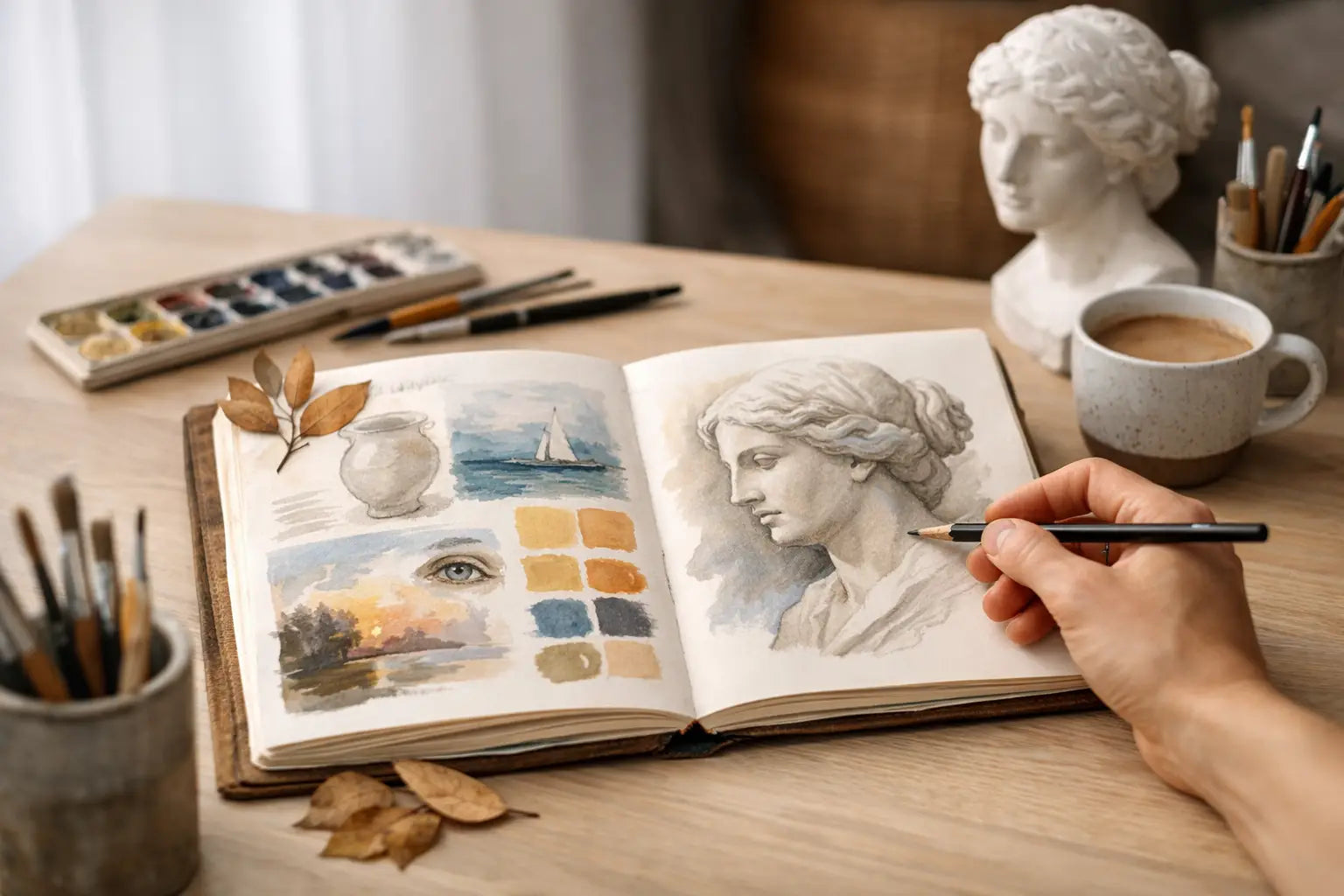
Visual notes can sit beside written ones. Make a color key, diagram a composition, paste in a printed image where appropriate, or write a quotation that changes the way you see the work. The journal should feel like a working archive, not a pristine object too precious to revise.
Return to earlier entries
The lasting value of journaling appears when you revisit it. After a month or a year, read an earlier entry beside a new one. Notice which descriptions have become more exact, which assumptions have softened, and which questions continue to follow you.
Revisiting also protects against the pressure to arrive at a final verdict. Your first response to an artwork may be incomplete, and your later response will be incomplete too. That is not a failure of expertise. It is the condition of a living relationship with art.
Set aside a page at the end of each month for connections: recurring colors, subjects, materials, political questions, or artists you want to pursue. These small acts of review turn individual entries into a body of thought. They also help you recognize your own tastes with more precision - not simply what you like, but what you return to, question, and value.
A serious art journal does not ask you to become a curator, critic, or scholar overnight. It asks for something both humbler and more durable: the willingness to look longer than usual, write honestly about what you find, and let each encounter prepare you for the next.